
AAMP 2.3: what changed and what it means for publishers

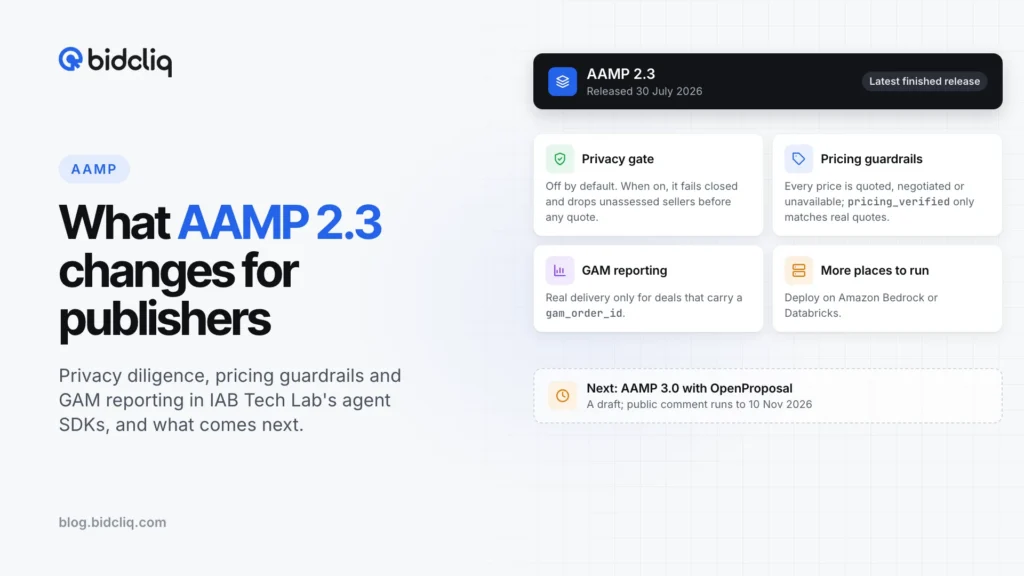
AAMP 2.3, released by IAB Tech Lab on 30 July 2026, is about making the reference buyer and seller agents safe to run with real money. For publishers, four changes matter: prices must trace back to something you quoted, availability must come from real numbers, delivery can come straight from Google Ad Manager, and buyers can now screen you out on privacy diligence before they ever ask for a quote.
It is still the latest finished AAMP release as of 29 October 2026. AAMP 3.0 has been announced, but its core spec is a draft out for public comment. Here is what 2.3 changed, where it sits, and what to do about it.
Where does AAMP 2.3 sit in the timeline?
AAMP moves fast, and the version numbers can confuse. The milestones, all from IAB Tech Lab’s own site:
- 26 February 2026: Tech Lab names AAMP (Agentic Advertising Management Protocols) as the umbrella for its agentic work.
- 4 March 2026: the Agent Registry launches as the trust and transparency pillar.
- 23 April 2026: AAMP 2.0 ships transaction-ready buyer and seller agent SDKs and adds deal types through the Deals API (programmatic guaranteed, preferred deals, PMPs, open marketplace and linear GRPs).
- 30 July 2026: AAMP 2.3.
- 12 August 2026: the Agentic Real Time Framework (ARTF), the real-time agent layer for OpenRTB, reaches a finalised v1.0.
- 22 September 2026: AAMP 3.0 is announced with OpenProposal as a public comment draft.
One trap: the AAMP hub repository says each repository uses independent semantic versioning. The buyer and seller agent repos are now at v2.4.2 (18 August 2026). That is code, not a new framework release. Tech Lab has not announced an “AAMP 2.4”.
What changed in AAMP 2.3?
Tech Lab’s press release groups the release into enterprise deployment, trusted transactions and industry contributions. The publisher-relevant parts:
| Area | What changed | Where it lives |
|---|---|---|
| Privacy diligence | IAB Diligence Platform and SafeGuard Privacy approval gate | Buyer agent |
| Pricing | Pricing provenance, deterministic negotiation guardrails, human approval outside value thresholds | Buyer and seller agents |
| Reporting | Google Ad Manager delivery reporting | Seller agent |
| Availability | Avails based on real, not derived, numbers; OpenDirect 2.1 avails format | Both |
| Channels | Meta buying via the Meta Marketing API | Buyer agent |
| Deployment | Amazon Bedrock AgentCore, Databricks, Streamable HTTP for MCP | Both |
The privacy gate in the buyer agent
The buyer agent can now check each seller against the buyer’s own tenant in the IAB Diligence Platform, run with SafeGuard Privacy. Per the buyer agent README, when SGP_ENFORCE=true:
- Sellers marked NOT APPROVED are removed at discovery, before quoting or booking.
- The gate fails closed. If the Diligence Platform is unreachable, no seller passes.
- Vendors not in the buyer’s portfolio follow
SGP_UNKNOWN_VENDOR_POLICY, which defaults toblock.
It is off by default. But once a buyer turns it on, an incomplete privacy assessment means your sales agent never shows up in that buyer’s results. Nothing in the logs on your side will tell you why.
Pricing guardrails and provenance
PPC Land summed up the release as blocking AI agents from inventing ad prices, and that is a fair read of the code. Tech Lab’s release post says a pricing provenance field now records where each price came from, and that LLM fallbacks that could invent CPMs were removed.
In the buyer agent, every price result carries a pricing_source of seller_quoted, negotiated or unavailable. On the seller side, the pricing guide makes verification quote-anchored. A proposal gets pricing_verified: true only if its CPM is within tolerance of a quote you issued to that buyer for that product. There is deliberately no rate card or floor fallback. So the order matters: quote first (POST /api/v1/quotes), then propose.
Negotiation is bounded too. The seller agent’s default strategy table runs from 3 rounds with a 3% per-round and 8% total concession cap for public buyers, up to 6 rounds with 6% and 20% for advertiser-level buyers. Counters never go below the product floor. These are defaults; set your own before going live.
The Deal Sync connector (seller agent v2.3.2) also refuses to create or clone a deal without a real floor price. And v2.4.2 fixed a case where a curated deal with an unknown product ID booked at a generic $12 CPM default. That fix is a good reminder of why provenance matters.
Google Ad Manager reporting
This is the part most publishers will touch first. The GAM reporting guide connects the seller agent to Ad Manager through the SOAP API with a service account:
GAM_ENABLED=true
GAM_NETWORK_CODE=12345678
GAM_JSON_KEY_PATH=/etc/secrets/gam-service-account.json
GAM_API_VERSION=v202505   # the guide's default; check it against Google's deprecation schedule
It exposes GET /gam/orders and GET /gam/report (order IDs plus a look-back window, 30 days by default). The deal performance endpoint then returns real impressions, fill rate and average CPM to buyer agents. The catch: that only works when the deal carries a gam_order_id. Without one, or without GAM configured, the endpoint returns placeholder stats with zero impressions. If agent-booked deals do not map to GAM orders, buyers will see nothing delivered.
Real availability
The seller agent now serves the OpenDirect 2.1 avails shapes (multi-product ProductAvailsSearch requests, per-product availsstatus). Optional fields with no data source, such as deliveryConfidence, are now left out instead of filled with nulls. availableImpressions stays required. In practice your forecast feed has to be real, because the agent will not invent one.
Everything else in the release
- Deployment: Amazon Bedrock AgentCore and Databricks options, MCP over Streamable HTTP with legacy SSE kept for older clients, pluggable storage (SQLite, Redis, Postgres plus Redis), and model support beyond Anthropic for OpenAI, Gemini and OpenAI-compatible services.
- Meta buying: the buyer agent can book and report on Facebook and Instagram campaigns through the Meta Marketing API. That puts open web inventory and Meta in the same buying tool.
- Contributions: a Deals Sync API MCP server from HyperMindz, and a Content Taxonomy parser from Mixpeek (IAB Content Taxonomy v3 classification, contextual discovery, brand safety scoring).
- Agentic Audiences v1.0: Tech Lab calls it ready for programmatic and agentic deals. The Prebid.js side is not new: the Agentic Audiences RTD module shipped in Prebid.js 11.6.0 in April and writes embedding segments into
user.data.
What changed after 2.3?
The SDK repos kept moving in August, and anyone self-hosting should know about two breaking changes in seller agent v2.4.0:
- Admin and mutation endpoints now need an operator-role API key. Buyer keys get a
403. You mint the first operator key on the host withad-seller create-operator-key. - Failed proposals return a structured
errors[]array with stable codes such aspricingandavailability.
v2.4.2 added idempotency on quotes, deals and negotiation messages, scoped per buyer. The buyer v2.4.1 notes say to pin buyer and seller versions together.
What is on the AAMP 3.0 roadmap?
AAMP 3.0 moves the framework up to the RFP and brief stage. Its core is OpenProposal, a spec for how sellers describe products and answer briefs so a buying agent can evaluate them. The repo describes it as 71 fields, of which only 3 need a round trip with the other party. Tech Lab says it links to AdCOM, OpenDirect and the Deals API, and will be built into the buyer and seller reference agents during the comment period.
Status matters here. OpenProposal is tagged v3.0-draft-1, and the README says plainly that nothing in it is a ratified standard. Tech Lab has extended public comment to 10 November 2026. You do not need to be a member to comment; a GitHub account is enough. IAB Australia has also opened expressions of interest for a seller-side pilot.
If you are weighing AAMP against AdCP, our AAMP and AdCP comparison covers the differences. The catalogue work is largely shared: see making inventory agent-ready for AdCP.
What to do next
- Get on your buyers’ approved lists. Ask your agency and brand buyers whether they use the IAB Diligence Platform, and finish their privacy assessment before they switch on the gate.
- Quote before you propose. If you run the reference seller agent, make sure your flow issues quotes so proposals come back
pricing_verified: true. - Set your own negotiation limits. Replace the default concession caps and floors with numbers your sales team has signed off.
- Map agent deals to GAM orders. No
gam_order_idmeans zero delivery reported to the buyer. - Check your avails source. The agent will report only what your forecast actually supports.
- Pin and upgrade together. Move buyer and seller agents to matching versions and plan for the v2.4.0 operator-key change.
- Comment on OpenProposal by 10 November 2026 if your product catalogue does not fit its model.
Disclosure: BidCliq builds header bidding and agentic tools for publishers, and our sales agent has been verified by AgenticAdvertising.org against AdCP 3.1.
Frequently asked questions
Is AAMP 2.3 the latest AAMP release?
It is the latest finished one. IAB Tech Lab announced AAMP 3.0 on 22 September 2026, but its core specification, OpenProposal, is tagged v3.0-draft-1 and is in public comment until 10 November 2026.
What is pricing provenance in AAMP 2.3?
It is a record of where each price in a negotiation came from. In the reference buyer agent every price is marked seller_quoted, negotiated or unavailable, and IAB Tech Lab says the LLM fallbacks that could invent CPMs were removed.
Does AAMP 2.3 integrate with Google Ad Manager?
Yes, for reporting. The reference seller agent can list GAM orders and run delivery reports through the GAM API, and it returns real impressions to buyer agents for deals that carry a GAM order ID.
What does the privacy diligence gate mean for sellers?
If a buyer switches it on, sellers marked not approved in that buyer's IAB Diligence Platform tenant are removed at discovery, before any quote. Sellers the buyer has not assessed are blocked by default.
Is there an AAMP 2.4?
IAB Tech Lab has not announced one. The buyer and seller agent repositories are at v2.4.2, but each AAMP repository versions independently, so those are code releases, not a new framework version.
About the author
Founder, BidCliq
Sharad Yadav is the founder of BidCliq, a publisher-first ad monetization platform that helps publishers and ad ops teams run header bidding, Prebid and programmatic across display, video, app and CTV. Before BidCliq, he led AdTech and product at GeeksforGeeks, where he built an in-house ads product that doubled programmatic revenue within nine months and an anti-adblock solution that lifted ad yield by 10%. He is a founding member of AdCP.