
IAB Tech Lab’s Agent Registry: should your sales agent be listed?

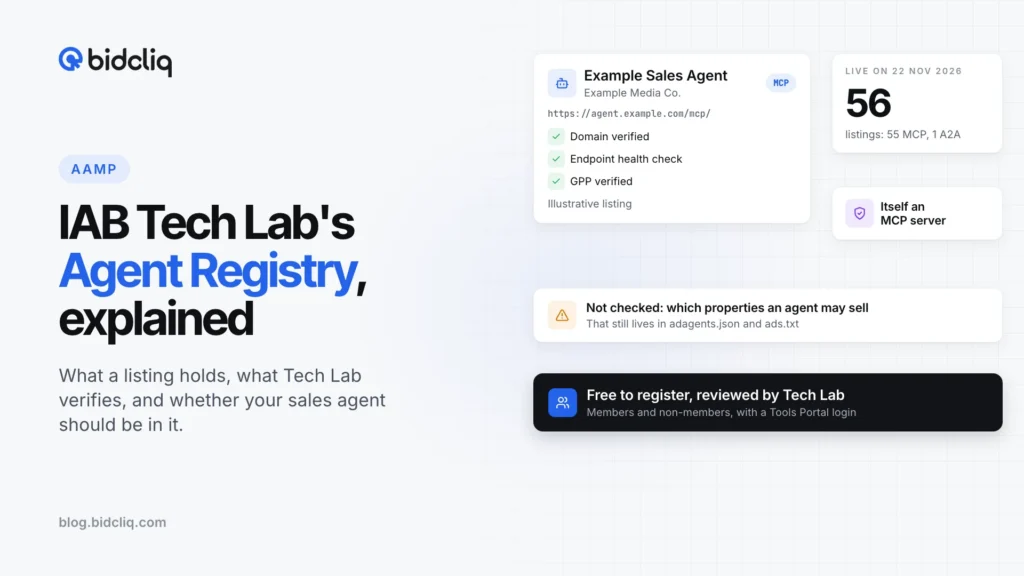
The Agent Registry is IAB Tech Lab’s public directory of advertising agents and MCP servers, and the trust and transparency pillar of its AAMP framework. If you run a sales agent you want buyers to find, register it: listing is free, and Tech Lab’s reference buyer agent can discover sellers straight from the registry. Just do not treat a listing as proof of anything beyond identity. It does not yet say which sites your agent may sell.
What is the Agent Registry?
IAB Tech Lab CEO Anthony Katsur introduced the registry in March 2026 as a directory of agentic advertising agents, meant to add trust and transparency to the market. It sits next to AAMP’s reference agents: the SDKs help you build an agent, and the registry helps partners find it and see what it does.
Three things make it more than a web page:
- It is public. You can browse registry.iabtechlab.ai without logging in. Registering or editing a listing needs a Tools Portal sign-in.
- It is an MCP server. Agents and tools such as Claude, Gemini or Cursor can query it directly at
https://registry.iabtechlab.ai/mcp(Streamable HTTP). The older/mcp/sseendpoint still works, but is deprecated. - It has a REST API.
GET /api/v1/agentsreturns every listing as JSON.
Tech Lab also publishes a small registry agent example that connects to the registry’s MCP server to browse, search and explain entries.
Who can list an agent?
Any company with a free Tools Portal login, member or not. Tech Lab reviews each entry to check the required validation information is there. Equativ and PubMatic were among the first registrants.
As of 22 November 2026 the registry holds 56 listings. A quick read of the live data:
- 55 are MCP servers and 1 is an A2A agent.
- 53 are remote, 2 private (on-premise or in a VPC) and 1 local (downloadable).
- The largest categories are ad server (10), SSP (9) and data provider (7). Five sit in the publisher category.
- 33 are marked GA, 20 beta and 3 alpha.
It is not AAMP-only. Six listings mention AdCP in their name or description, including publisher sales agents whose descriptions say they speak AdCP 3.1. One describes itself as speaking both AdCP and AAMP discovery tools. If you run an AdCP sales agent, you can list it here.
What does a listing contain?
The REST API shows the full record. The fields that matter for a sales agent:
| Field | What it holds |
|---|---|
agent_name, legal_name | Agent name and the company behind it |
primary_domain | The company domain the listing claims |
endpoint_url | Where buyer agents connect |
protocol_type, type | mcp or a2a; remote, local or private |
category | One of Tech Lab’s categories, such as publisher, ssp or ad-server |
status | Maturity: alpha, beta or ga |
capabilities, discovered_tools | Tool names and descriptions read from the endpoint |
auth_required | Whether buyers need credentials to call it |
gpp_id | The company’s Global Privacy Platform ID, if any |
domain_verified, gpp_verified, endpoint_health_verified | The three verification checks |
endorsements | Certifications such as Open Measurement or IAB UK Gold Standard |
The three verification flags carry most of the trust signal. On 22 November, 46 listings were domain verified, 48 passed the endpoint health check and only 15 were GPP verified. Many publishers will not have a GPP ID (Tech Lab’s GPP IDs include TCF Global Vendor List IDs), and the numbers show that has not kept listings out.
How are buyers expected to use it?
The simple version: browse by category, read what each agent does, and connect. The more interesting version is in Tech Lab’s reference buyer agent.
When a buyer sets AAMP_REGISTRY_URL, the buyer agent’s registry client pulls the agent list from the registry and filters it on the capabilities each listing declares. To check a specific seller, it matches the seller’s endpoint URL against endpoint_url in the registry:
- A listing with
verification_statusofactivemaps to verified. - Any other listing maps to registered.
- An endpoint not in the registry comes back unknown.
Two caveats keep this honest. The registry is a discovery path, not a gate: a buyer can still point its agent at your endpoint directly with SELLER_ENDPOINTS, and the multi-seller orchestrator only drops sellers marked blocked. And the setting is off by default. Still, a buyer that relies on registry discovery will never see a sales agent that is not listed.
How are sellers expected to use it?
Mostly the other way round: to check who is calling. The reference seller agent keeps its own trust list of buyer agents, and an operator promotes a buyer from unknown to approved with PUT /registry/agents/{agent_id}/trust. When AAMP_REGISTRY_URL is set, the seller agent can also query the Tech Lab registry. So before you give an unfamiliar buyer agent better pricing tiers or access, look it up and check its verification flags.
The seller agent also publishes its own agent card at /.well-known/agent.json, which buyers can fetch directly to refresh what a known seller offers.
What the registry does not do yet
A verified domain proves the listing company controls that domain. It does not prove the agent may sell a particular site. In March, Tech Lab put an ads.txt-style check, verifying that a seller agent really represents a property, on its roadmap. The current listing schema has no property field.
Until that lands, keep property authorisation where it already lives: ads.txt and sellers.json for programmatic paths, and adagents.json if you also sell through AdCP. Our guide to making inventory agent-ready for AdCP covers adagents.json. For how the two standards relate, see AAMP and AdCP compared.
Should a publisher register its sales agent?
Yes, if three things are true:
- The agent is reachable. A remote endpoint that answers, because endpoint health is one of the three checks.
- You want buyers to find it. If it only serves two agencies you onboarded by hand, a listing adds little.
- You can describe it honestly. Pick
alphaorbetaif that is what it is, say whether it books or only discovers, and say whether buyers need credentials.
There is little downside. It is free, and a good listing tells a buyer agent what your tools do before it calls them.
How do you register?
- Sign in to the IAB Tech Lab Tools Portal, or create a free account, and open Agent Registry, then Register Agent.
- Fill in the basics. Agent name, legal name, primary domain (the one in your sellers.json and ads.txt), endpoint URL, protocol, deployment type, category (
publisherfor your own sales agent), status, description and logo. Add documentation and support links; buyers need them. - Make sure the endpoint answers so the health check passes. Expose clear tool descriptions; those are what buyers and their agents read.
- Wait for Tech Lab’s review, then check your listing the way a buyer would.
The second half of step 4 takes a minute. The registry’s auth.md describes an anonymous, read-only 60-minute credential:
curl -s -X POST https://registry.iabtechlab.ai/agent/identity \
  -H 'Content-Type: application/json' -d '{"type":"anonymous"}'

# 2. Exchange it for a 60-minute access token (scope registry.read)
curl -s -X POST https://registry.iabtechlab.ai/oauth2/token \
  --data-urlencode 'grant_type=urn:ietf:params:oauth:grant-type:jwt-bearer' \
  --data-urlencode 'assertion=<identity_assertion>'

# 3. List agents and find yours
curl -s -H 'Authorization: Bearer <access_token>' \
  https://registry.iabtechlab.ai/api/v1/agents
Check that your endpoint_url is exactly what buyers will call, since the reference buyer agent matches on it.
Checklist
- Sales agent endpoint is public, healthy and has clear tool descriptions.
- Tools Portal account created; listing submitted under the
publishercategory. - Primary domain matches your sellers.json and ads.txt domain, and the listing shows
domain_verifiedas true. - Status and
auth_requiredreflect reality. - Listing checked through the REST API after approval.
- ads.txt, sellers.json and, for AdCP, adagents.json still current. The registry does not replace them.
- Unfamiliar buyer agents checked against the registry before you grant them trust.
Disclosure: BidCliq builds header bidding and agentic tools for publishers.
Frequently asked questions
What is the IAB Tech Lab Agent Registry?
It is a public directory of advertising agents and MCP servers run by IAB Tech Lab as the trust and transparency pillar of AAMP. Buyers, sellers and their agents can browse it on the web or query it over REST and MCP.
Who can register an agent in the Agent Registry?
Any company with a free IAB Tech Lab Tools Portal login, whether or not it is a Tech Lab member. Tech Lab reviews each entry before it goes live.
Can I list an AdCP sales agent in the IAB Tech Lab registry?
Yes. The registry lists MCP and A2A agents regardless of which ad protocol they speak, and several current listings describe themselves as AdCP sales agents.
Does a registry listing prove an agent can sell my inventory?
No. Domain verification shows the listing company controls its primary domain, not that it may sell a given site. Tech Lab has said property-level verification, an ads.txt for agents, is on its roadmap.
Do I need a GPP ID to register?
IAB Tech Lab ties registering companies to their GPP ID, but most publishers do not have one. As of 22 November 2026, 41 of the 56 live listings show no GPP verification, so a missing GPP ID has not kept agents out.
About the author
Founder, BidCliq
Sharad Yadav is the founder of BidCliq, a publisher-first ad monetization platform that helps publishers and ad ops teams run header bidding, Prebid and programmatic across display, video, app and CTV. Before BidCliq, he led AdTech and product at GeeksforGeeks, where he built an in-house ads product that doubled programmatic revenue within nine months and an anti-adblock solution that lifted ad yield by 10%. He is a founding member of AdCP.